
OPINION - US' 2026 defense budget signals what's coming: Where is Washington headed?
John Mearsheimer warned that great powers' always compete.' 2026 NDAA confirms that US has stopped viewing this competition as a contest of diplomats. It is now a contest of assembly lines.- US government has stopped viewing its economy as a commercial engine and started viewing it as a producing one. This is the shift from presence (protecting the line) to production (feeding the machine), caused by competing with a production giant, China
By Utku Asker
- The author is an Anadolu correspondent.
ISTANBUL (AA) - "The sad fact is that international politics has always been a ruthless and dangerous business, and it is likely to remain that way. Although the intensity of their competition waxes and wanes, great powers fear each other and always compete with each other for power." John Mearsheimer wrote those words in 2001, describing the "tragedy" of great power politics. Yes, the intensity of the competition does wax and wane, as can be seen throughout the diplomatic theater of 2025, especially under US President Donald Trump’s name, but the competition is always there.
Diplomatic engagements are holding still, but if we want to know the actual trajectory of the future, we must look away from the podiums and into the fine print of the US National Defense Authorization Act (NDAA) for 2026.
Normally, there are three lenses through which to read the NDAAs. First, US engagement with the world, what Washington now wants to do in a world long defined by rivalry. Second, the state of the US defense industrial base, which the US now believes it must be able to make, stock, and replace at scale. Third, target geographies and alliance design, which theaters get industrialized partnerships and which get classic basing and burden shift. According to these parameters, the 2026 NDAA shows that the US is moving away from a posture built on being present in the right places, militarily or diplomatically (the US decided to leave 31 international organizations on Jan. 7, claiming that they are contrary to its interests) and looking after alliances, to a posture built on being able to produce and regenerate at the speed a prolonged rivalry would demand. The underlying bet is that deterrence in the coming decade will be tested less by episodic shows of force and more by endurance under stress.
- US engagement with the world
In December, the US released its 3,086-page NDAA, up from 794 pages in 2024, authorizing over $900 billion in defense spending. However, more important than the numbers in it, the bill edits the source code of US engagement with the world, and is plainly revising the course of their military understanding. Shifting from a posture of presence, as former US Army Chief of Staff Raymond Odierno said, “Preventing conflict demands presence, shaping the environment demands presence, restoring the peace demands presence, and more often than not, that presence proudly wears the uniform of an American soldier” to a posture of production. Meaning industrial capacity, supply chain resilience, and the ability to manufacture faster than the rival can endure. This is the logic of attrition.
The primary reason for this shift is China, representing a challenge defined not just by firepower, but also by industrial flow. In contrast with before, the US is facing a rival with a distinct economic edge, an unmatched control over natural resources and critical minerals essential for modern defense, coupled with a production capacity that allows it to generate combat power at scale. It is a contest against a "world factory" that can mobilize its industrial base for attrition in ways the US is now scrambling to replicate. This reality is compounded by the lessons of industrial warfare in Ukraine, where the mobilization of low-cost and mass-produced drone fleets as well as CRBMs has proven that in a high-intensity fight, the victor is often the side that can produce the longest.
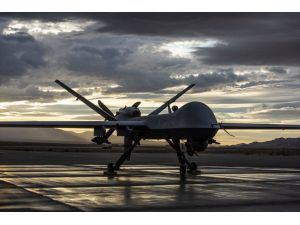
The character of war is pushing everything in this direction. The text authorizes specific funds for "attritable unmanned vehicles," acknowledging that the battlefield is becoming a place of mass consumption. More drones, more sensors, more munitions, accelerated turnover. This pivot serves a dual purpose, as beyond military readiness, it strengthens the US economic hand through localization. By prioritizing domestic manufacturing and supply chain resilience, Washington aims to insulate itself from global shocks and rebuild the industrial muscle that has degenerated over the last decades.
There is an entire subtitle for matters relating to Israel, and the most profound evidence of this shift is found in Section 1233 of the NDAA. The text amends the previous law to expand emergency powers. Where the section once referred to supplying "Israel" it is now “Israel, or the United States defense industrial base.”
The "United States defense industrial base" is now legally equivalent to an ally that the US is defending at all costs. The US government has stopped viewing its economy as a commercial engine and started viewing it as a producing one. This is the shift from presence (protecting the line) to production (feeding the machine), caused by competing with a production giant, namely China.
- State of US defense industrial base: Era of the attritable
The beginning of the NDAA openly says that an assessment of the projected munitions stockpiles of the military forces of Russia, China, Iran, and South Korea is to be handed to the congressional defense committees by the defense secretary (which has been rebranded “secretary of war,” but surprisingly is still called in the act “secretary of defense”), which directly names the rivals and signals the importance of production capacity.
Again, the NDAA also openly presents the need for an assessment of the lessons learned from the war in Ukraine, signaling the need to redesign the US Army in light of attrition warfare’s rising importance. This brings us to the new vocabulary of the American army: "attritable."
In Section 867, under "Modifications to Defense Industrial Base Fund," the text authorizes funds specifically for “attritable unmanned vehicles,” and adds “Advanced manufacturing capability and capacity of the defense industrial base, including manufacturing at or near the point of need in the area of responsibility of the United States Indo-Pacific Command.”
They are trying aggressively to export this "production" mindset to their alliances, as can be seen in previous sections. Section 1253 establishes a "Partnership for Indo-Pacific Industrial Resilience." The word choice is interesting for a defense act. Not a defense partnership but an industrial one, which again, points to the change in trajectory.
- Alliance design: Burden sharing or burden charging?
One may see Israel (Section 1232) integrated into "all warfighting domains" of unmanned systems or Taiwan getting joint programs for uncrewed fielding. These are the allies chosen to be mentioned in joint programs in the NDAA, while in terms of NATO allies, the main agenda is burden sharing.
Section 1246 says “such burden sharing contributions expanded” as well as “to reduce the total number of members of the Armed Forces ... of the United States European Command” and “to ensure that other members of NATO have available capabilities and capacity to assume the roles and responsibilities of the United States Armed Forces,” all of which are clear signs of burden sharing or, one may call it burden charging.
But where is Türkiye? In a bill that details partnerships, the silence on NATO’s second-largest army may seem odd. The same goes for Italy, Germany, and France, except for naming the bases in these countries. While the "production" partners get access to the future of robotics and AI, traditional "presence" partners remain in the legacy box of bases and treaties.
As quoted above, Mearsheimer warned that great powers "always compete." The 2026 NDAA confirms that the US has stopped viewing this competition as a contest of diplomats. It is now a contest of assembly lines. The report's underlying message is that the US will try to win the next round of great-power competition by owning the inputs (energy, minerals, supply chains) and scaling the outputs (munitions, unmanned systems, industrial surge). The Venezuela oil move, the Greenland assertion, and the industrial transformation of the US-Israel partnership all seem to convey the same message that Washington is treating supply chains, energy flows, and production capacity as instruments of power and treating deterrence as a contest of who can replenish faster and endure longer.
*Opinions expressed in this article are the author’s own and do not necessarily reflect the editorial policy of Anadolu.
Kaynak:
This news has been read 81 times in total





Türkçe karakter kullanılmayan ve büyük harflerle yazılmış yorumlar onaylanmamaktadır.